
There are few experiences more universally stressful than the sudden, sickening realization that your vehicle is failing you while you are out on the open road. Picture the scenario: you are driving home late at night on a poorly lit highway, or perhaps you are navigating through dense, aggressive rush-hour traffic when the dashboard suddenly illuminates with a barrage of red warning lights. The engine begins to sputter, a harsh grinding noise echoes from beneath the floorboards, and the steering wheel shudders violently in your hands. In an instant, your reliable mode of transportation transforms into a two-ton metal box of vulnerability. You manage to muscle the car onto the shoulder of the road, the engine dies completely, and you are left sitting in the silence, enveloped by a profound sense of helplessness.
In this moment of high anxiety, physical vulnerability, and impending financial dread, the very last thing you want to do is pull out your smartphone and blindly search the internet for a stranger to rescue you. Waiting until your vehicle is completely undrivable to find a mechanical professional practically guarantees that you will be forced to make desperate, uninformed decisions. When you are stranded, you do not have the luxury of reading through pages of customer reviews, comparing hourly labor rates, or interviewing service writers about their warranty policies. You are entirely at the mercy of whoever happens to be available, which often leads to grossly overpaying for services, accepting unnecessary upcharges, or falling victim to subpar workmanship.
The core message every vehicle owner must internalize is that proactive relationship-building is the ultimate safeguard against automotive disasters. Treating your car’s health as a passive afterthought—waiting for components to fail before addressing them—is an incredibly expensive and dangerous way to manage your primary asset. Just as you would not wait until you are suffering a massive heart attack to find a primary care physician, you should not wait for a catastrophic engine failure to find a trusted automotive technician.
This comprehensive, in-depth guide will walk you through the undeniable benefits of establishing a relationship with a mechanic while your car is still running perfectly. Over the course of the following sections, we will explore exactly how to audit your vehicle’s health, how to rigorously vet professionals before an emergency forces your hand, and how to protect both the structural safety and the long-term financial value of your automotive investment. By the time you finish reading, you will understand how to transform the unpredictable stress of car ownership into a highly manageable, predictable routine.
The High Cost of Reactive Maintenance
The automotive industry is built on a fundamental truth: treating car care as a reactive afterthought almost always results in exponentially higher bills. Modern vehicles are incredibly complex marvels of engineering, consisting of thousands of interconnected moving parts operating under extreme heat, immense friction, and intense pressure. When a single, inexpensive component is neglected, its failure rarely happens in isolation. Instead, it creates a domino effect, placing undue stress on adjacent, highly expensive engine parts. Relying on a strategy of waiting until a part breaks before you address it is the fastest way to drain your savings account on massive vehicle repairs that could have been easily avoided.
-
Track Your Mileage and Fluid Changes Logically
The lifeblood of your vehicle is its fluids. Engine oil, transmission fluid, coolant, and brake fluid all degrade over time, losing their viscosity and their ability to protect internal metal components from friction and heat. Relying purely on memory to track these changes is a recipe for disaster. You must adopt a logical, documented approach. Create a simple spreadsheet or download a dedicated vehicle maintenance smartphone app to log every single service. By actively monitoring these intervals, you can schedule appointments with a local auto repair provider on your own terms, rather than waiting for the engine to seize. Clean oil ensures microscopic metal shavings are carried away from the engine bearings, while fresh coolant prevents the aluminum engine block from warping under the extreme heat of summer driving. A fifty-dollar fluid change today prevents a five-thousand-dollar engine replacement tomorrow.
-
Learn to Identify Minor Oddities Before They Escalate
A car rarely fails completely without giving you subtle warning signs first. Becoming an active, engaged driver means learning how to “listen” to your vehicle and recognizing deviations from its normal baseline behavior. Pay close attention to how the car feels and sounds during your daily commute. Do you feel a new, subtle vibration in the steering wheel when you reach highway speeds? Does the transmission hesitate for half a second before shifting into the next gear? Does the car pull slightly to the left when you brake? These are all early warning indicators of impending mechanical issues. Addressing a minor vibration early might simply require a cheap wheel balance; ignoring it for six months will destroy your wheel bearings and your suspension joints. Catching these oddities early keeps the fixes cheap and manageable.
Vetting Professionals Before the Check Engine Light Blinks
Finding a genuinely honest, highly skilled mechanic requires a clear head, a critical eye, and the luxury of time to do proper research. These are three assets you completely lack when your car is spewing smoke on the side of the road and being loaded onto the back of a flatbed truck. The time to interview and screen mechanical professionals is right now, while your vehicle is running flawlessly. By taking the time to carefully evaluate the businesses in your community, you can confidently establish a long-term relationship with an auto repair shop that prioritizes customer education and transparent pricing over aggressive sales tactics.
-
Look for ASE Certifications and Specialized Training
The automotive repair industry is highly technical, and you should never hand your keys to someone who cannot prove their competency. When vetting a potential mechanic, the very first thing you should look for is the blue seal of the National Institute for Automotive Service Excellence (ASE). ASE certification requires technicians to pass rigorous, comprehensive exams that test their deep technical knowledge of engine performance, electrical systems, suspension, and more. Furthermore, if you drive a specific, complex make of vehicle—such as a German luxury sedan or a hybrid electric car—you must seek out technicians who have specialized, manufacturer-specific training. The computer diagnostics required for modern vehicles are incredibly intricate, and an independent auto repair garage that invests in continuous education for its staff is a business that takes its craft seriously.
-
Test a New Facility With a Routine Oil Change
You should never trust a completely unvetted mechanic with a massive, multi-thousand-dollar engine overhaul on your very first visit. The smartest way to evaluate a new facility is to schedule a low-stakes, routine service, such as a basic oil change or a tire rotation. Use this visit purely as an intelligence-gathering mission. Evaluate the cleanliness and organization of the waiting room and the service bays. Pay close attention to the demeanor of the service writers at the front desk. Do they take the time to clearly explain the invoice, or do they aggressively push unnecessary fluid flushes and questionable upgrades? A trustworthy mechanic will provide you with a documented inspection report, tell you what looks great, point out what might need attention in the next six months, and never pressure you into an immediate, panic-driven purchase.
Prioritizing Safety-Critical Systems on Your Schedule
A trusted professional mechanic does more than just fix broken parts; they act as your automotive advisor, helping you strategically plan for the replacement of expensive, safety-critical wear items. When you have an open line of communication with a reliable technician, you are never caught off guard financially or physically by failing components. You can budget for necessary maintenance months in advance, ensuring that your vehicle remains fundamentally safe to operate in unpredictable conditions, and establishing a rock-solid contingency plan for when the unexpected inevitably occurs on the road.
-
Listen for Squeals and Measure Pad Thickness Annually
Your vehicle’s braking system is the single most important safety feature it possesses. It does not matter how powerful your engine is if you cannot bring the vehicle to a controlled stop in an emergency. Brake pads are designed to slowly wear away with use, but many drivers ignore them until they hear the horrific sound of metal grinding against metal. Most brake pads feature a small metal wear indicator that emits a high-pitched squeal when the pad is getting dangerously low. You must never ignore this sound. Even better, have your trusted mechanic physically measure the pad thickness in millimeters every time you get your tires rotated. By scheduling proactive brake services before the friction material is completely gone, you save yourself the massive expense of having to replace deeply gouged metal rotors and ruined brake calipers.
-
Program Roadside Assistance Numbers Into Your Phone Now
Even with the most meticulous preventative maintenance routine in the world, tires can hit massive potholes and sharp debris, and alternators can suddenly short out without warning. Total roadside immobility is sometimes unavoidable. To prevent a bad situation from becoming a complete nightmare, you must have your emergency protocols established well in advance. Check your auto insurance policy to see if you have roadside coverage, or consider joining a third-party roadside assistance club. Once you have a plan, program the direct dispatch numbers into your phone and write them down on a physical card to keep in the glove compartment. Knowing exactly who to call for reliable emergency towing ensures that your vehicle is transported safely to your pre-vetted mechanic’s lot, rather than being dragged to a random, overpriced impound yard by predatory towing operators who monitor police scanners.
Protecting Your Field of Vision and Cabin Safety
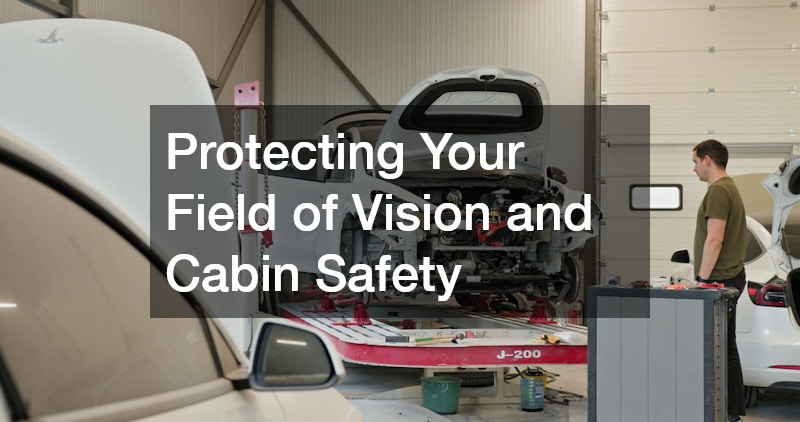
When discussing automotive safety, most people immediately think of airbags, anti-lock brakes, and crumple zones beneath the hood. However, clear visibility and the structural integrity of your vehicle’s cabin are equally vital to surviving an accident or avoiding one altogether. Your vehicle’s exterior glass is not just a shield against the wind and rain; it is a highly engineered, load-bearing component of the car’s architecture. Failing to properly maintain and immediately repair damage to your windows compromises the entire safety cage designed to protect you and your passengers.
-
Address Tiny Star Breaks the Same Week They Happen
Driving down the highway, it is incredibly common for a commercial truck to kick up a small piece of gravel that strikes your window, leaving a tiny, star-shaped chip. Most drivers ignore these small blemishes because they do not immediately obstruct their line of sight. This is a critical mistake. Auto glass is constantly subjected to immense stress from the twisting of the car’s chassis over bumps, as well as extreme thermal shock. On a hot summer day, blasting your air conditioning on the inside while the sun bakes the outside creates massive temperature differentials. Within a matter of days, that tiny star break will aggressively split into a massive, unrepairable spiderweb crack stretching across your entire field of vision. Addressing a small chip immediately with a cheap resin injection saves the structural integrity of the glass and prevents a total replacement.
-
Ensure Proper Calibration for Advanced Driver-Assistance Systems
If a crack does become too large to repair, replacing the window on a modern vehicle is no longer a simple matter of popping out the old glass and gluing in a new pane. Today’s vehicles are equipped with Advanced Driver-Assistance Systems (ADAS). The cameras, lasers, and sensors that power your automatic emergency braking, lane-keep assist, and adaptive cruise control are almost entirely mounted directly behind the rearview mirror, looking out through the glass. When the glass is replaced, these highly sensitive cameras are moved, throwing off their alignment. If they are misaligned by even a fraction of a millimeter, your car might slam on the brakes for a shadow or fail to detect a stopped car ahead. Therefore, you must use a highly specialized windshield replacement company that possesses the expensive digital recalibration equipment required to perfectly realign your car’s safety computers after the new glass is installed.
Preserving Long-Term Value Through Exterior Care

A truly proactive, financially savvy car owner understands that protecting the mechanical engine is only half the battle. The physical exterior of your vehicle is subjected to a brutal, unending assault from the natural environment every single day. Over time, UV radiation, chemical contaminants, and physical abrasion will destroy your vehicle’s clear coat, leading to deep structural rust and massive depreciation in the vehicle’s resale value. Establishing a rigorous exterior maintenance routine is essential to preserving the long-term financial equity you hold in your automotive investment.
-
Wash Off Corrosive Road Salt and Bird Droppings Immediately
The environment is actively trying to consume your vehicle’s exterior. In winter climates, the heavy road salt used to melt ice is highly corrosive; if left to sit in the wheel wells and undercarriage, it acts as a catalyst for aggressive rust that will literally eat through the metal floorboards and suspension components. In warmer months, bird droppings and tree sap pose an equally destructive threat. Bird guano is highly acidic, and when left to bake into the surface under the hot sun, the acid will etch permanently into the paint, leaving dull, cloudy spots that cannot be polished out. You must make it a strict habit to wash your vehicle frequently, paying special attention to immediately removing these chemical hazards the moment you spot them on the hood or roof to preserve the physical integrity of the body panels.
-
Apply Protective Layers to Guard Against UV Fading
Washing the car removes the dirt, but you must also apply an active, sacrificial barrier to protect the underlying color from the bleaching effects of the sun’s ultraviolet rays. For decades, car owners relied on traditional carnauba waxes to provide a temporary, glossy shine, but these organic waxes melt off after just a few weeks in the summer heat. Today, you must utilize high-quality auto paint protections, such as synthetic polymer sealants, which chemically bond to the surface and provide months of durable defense against UV fading and environmental fallout. For those looking for the ultimate, multi-year defense, investing in an advanced auto ceramic coating provides a semi-permanent, glass-like hydrophobic barrier. This liquid polymer cures into a rigid shield that repels water, prevents chemical etching, and keeps the exterior looking showroom-new for years, drastically increasing what buyers will pay when you eventually decide to sell the vehicle.
Conclusion
Navigating the responsibilities and inherent risks of car ownership does not have to be a constant source of underlying anxiety. While the mechanical systems that propel you down the highway at seventy miles per hour are undeniably complex and prone to eventual wear, the strategies required to manage them are highly accessible. By shifting your mindset away from reactive panic and embracing a philosophy of proactive, documented care, you instantly transform your vehicle from a mysterious liability into a predictable, manageable machine.
The peace of mind that comes from knowing exactly who to call when things go wrong is invaluable. It allows you to travel with confidence, knowing that you have built a safety net of vetted professionals who have your best interests—and your budget—in mind. You are no longer an easy target for predatory pricing during an emergency because you have already done the difficult work of establishing trust.
Taking control of your car’s health and your financial future starts right now, while your vehicle is safely parked in your driveway. Take ten minutes today to perform a simple visual inspection of your tires, check your fluid levels, and verify your emergency roadside numbers. Most importantly, begin the research process this week. Ask friends for recommendations, read up on local facilities, and schedule that low-stakes introductory oil change. By taking these highly actionable steps today, you ensure that when the unexpected inevitably happens on the road, you are ready to handle it with absolute confidence.