
Transforming an aging, underutilized, or dilapidated commercial property into a modern, highly profitable asset is one of the most exciting, yet formidable, undertakings in real estate investment. Often, the smartest path to maximizing your return on investment is not a simple renovation, but a complete teardown and rebuild. This process allows you to wipe the slate clean, removing the hidden liabilities of outdated infrastructure and replacing them with a custom-designed facility that perfectly meets the demands of the current market. However, the journey from an old, crumbling structure to a gleaming new edifice is fraught with complexities, logistical nightmares, and severe financial risks if not managed with absolute precision.
The challenges are multifaceted. Property managers and investors must navigate a labyrinth of local ordinances, environmental regulations, supply chain bottlenecks, and the unpredictable nature of subterranean site conditions. A single misstep during the early phases can cause a cascade of delays, leading to massive budget overruns that severely impact the project’s ultimate profitability. Therefore, success relies entirely on a foundation of meticulous planning, proactive risk mitigation, and seamless, authoritative project management.
This comprehensive master guide is designed to walk you through the entire lifecycle of a total property transformation. By breaking down the transition into distinct, manageable phases, you will learn how to orchestrate the teardown safely, navigate the bureaucratic red tape effectively, and manage the ensuing reconstruction with confidence. From the initial structural audit to the final walkthrough of your new building, this article provides the actionable insights required to keep your ambitious commercial redevelopment on track, on time, and on budget.
Phase 1: Assessing the Site and Planning the Tear-Down
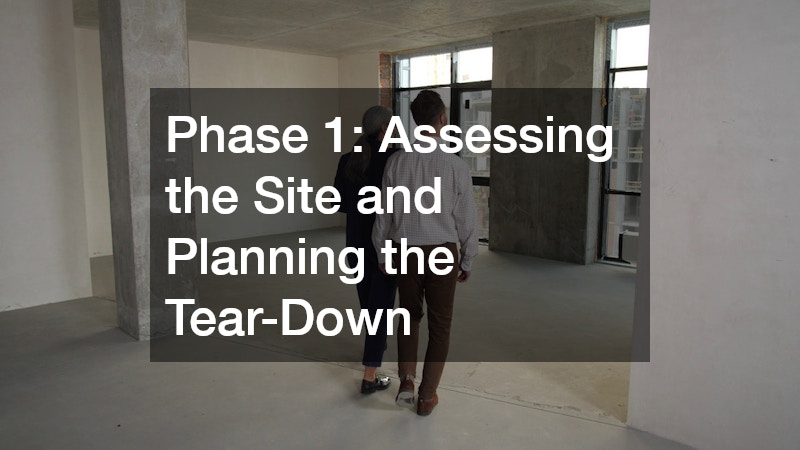
Before a single piece of heavy machinery arrives on your property, an exhaustive assessment and planning phase must occur. This is not the time to rush. The decisions made during these initial weeks will dictate the financial trajectory of the entire project. Bringing in a highly experienced commercial demolition contractor early in the process is crucial, as their initial site evaluation can reveal structural realities that significantly impact your project budget. Furthermore, partnering with a well-reviewed local demolition company ensures that your planning phase respects community guidelines, neighborhood nuances, and specific municipal expectations right out of the gate.
Conduct a Thorough Pre-Project Structural Audit
A comprehensive structural audit is your first line of defense against unforeseen catastrophes. This is an exhaustive, physical inspection of the existing structure to determine exactly what you are dealing with before the walls come down.
-
Foundation Integrity: Assess whether the existing foundation can be reused or if it must be completely excavated. Reusing a foundation can save hundreds of thousands of dollars, but only if it meets the load-bearing requirements of your new design.
-
Load-Bearing Dynamics: Understand the engineering of the current building. Knowing how the building supports its own weight dictates the sequence in which it must be taken down to prevent a premature, uncontrolled collapse.
-
Adjoining Structures: If your property shares a wall or sits directly adjacent to another business, you must assess how the teardown will impact their structural integrity. You may need to install temporary shoring or underpinning to protect neighboring assets.
-
Material Identification: Document the primary materials used in the original build—such as reinforced concrete, heavy timber, or structural steel—as this will dictate the machinery required for the job.
Map Out Utility Disconnections and Asset Salvage
Failing to properly manage utilities and salvageable assets is a common, yet easily avoidable, mistake that costs property owners dearly.
-
Utility Disconnection Protocols: You must legally and safely cap all incoming utilities. This involves coordinating with municipal water, sewer, electrical, and natural gas providers. Gas lines must be purged and capped at the street level. Electrical mains must be completely severed and verified dead by an independent inspector. Failure to do so can result in fatal accidents or catastrophic neighborhood blackouts.
-
Strategic Asset Salvage: Before the heavy destruction begins, conduct a “soft strip” of the building. Identify assets that hold significant resale or recycling value.
-
Metals: Copper wiring, aluminum fixtures, and structural steel beams can be sold to scrap yards to offset project costs.
-
Architectural Salvage: Hardwood flooring, vintage brickwork, and ornate facades often carry a premium in the secondary architectural market.
-
Mechanical Equipment: Industrial HVAC units, generators, and commercial boilers—if relatively modern—can be auctioned or sold directly to refurbishers.
-
Phase 2: Navigating Permits, Safety, and Environmental Compliance
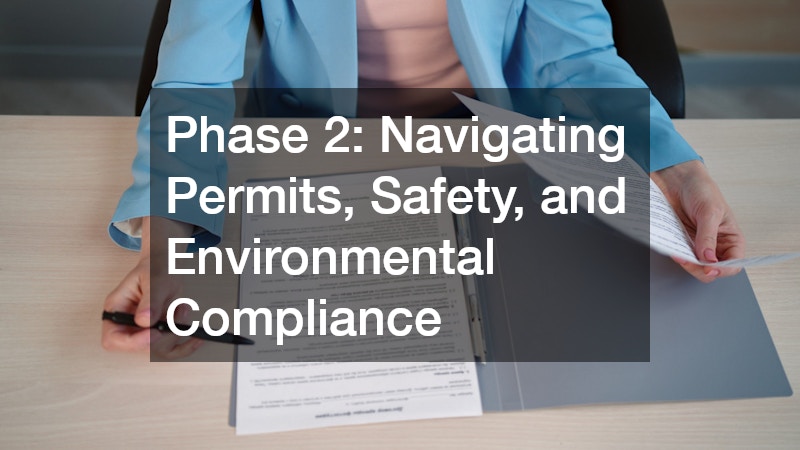
The bureaucratic and regulatory phase of a teardown is often the most frustrating, but it is absolutely essential. The red tape exists to protect the public, the environment, and your financial liability. A reputable demolition business will always prioritize legal compliance and safety above speed. Trying to cut corners here will inevitably lead to stop-work orders, massive municipal fines, and potential lawsuits. This is why investing in comprehensive demolition services that explicitly include permit handling and environmental testing is a non-negotiable expense for any serious commercial property owner.
Secure Municipal Clearances Well Before Your Start Date
Municipalities do not move at the speed of business; they move at the speed of bureaucracy. Therefore, permit acquisition must begin months in advance.
-
Teardown Permits: This is the primary legal document granting you permission to remove the structure. It usually requires submitting detailed methodologies and safety plans.
-
Zoning and Land Use Approvals: Ensure that what you intend to build is actually allowed on that specific parcel of land. You may need to apply for variances if your new structure exceeds height restrictions or requires different parking ratios than the previous building.
-
Traffic and Right-of-Way Permits: If heavy machinery will block lanes of traffic, or if scaffolding will encroach on public sidewalks, you must secure street closure permits. This often involves submitting a highly detailed traffic control plan to the city’s transportation department.
-
Noise Ordinance Waivers: Commercial teardowns are incredibly loud. If you plan to work outside of standard hours (such as early mornings or weekends to expedite the timeline), you must secure explicit noise waivers from the city council.
Implement Strict Hazardous Material Protocols
Older commercial buildings are frequently laden with toxic materials that are harmless when undisturbed but highly dangerous when broken apart and aerosolized.
-
Asbestos-Containing Materials (ACM): Commonly found in floor tiles, pipe insulation, roofing mastics, and acoustic ceiling tiles. An independent hygienist must test the site. If asbestos is found, it requires containment, negative air pressure environments, and specialized disposal by certified technicians before general work can begin.
-
Lead-Based Paint: Pre-1978 buildings almost certainly contain lead paint. Dust mitigation strategies, including constant water suppression and specialized HEPA-filtered vacuums, must be employed to protect both workers and the surrounding neighborhood from lead poisoning.
-
Polychlorinated Biphenyls (PCBs) and Mercury: Old fluorescent light ballasts, transformers, and certain caulking materials may contain PCBs or mercury. These must be carefully extracted and transported to specialized hazardous waste processing facilities under strict EPA guidelines.
Phase 3: Executing the Teardown and Clearing the Slate
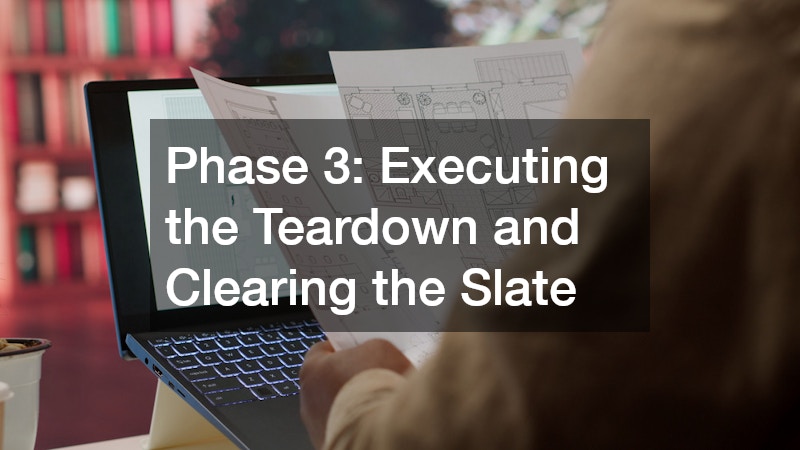
Once the soft strip is complete, utilities are capped, and all hazardous materials are abated, the actual physical teardown can commence. This is the most visually dramatic phase of the project. It is crucial to remember that top-tier demolition contractors do not simply smash buildings to the ground; they methodically dismantle them to prepare the canvas for the next phase. The transition from destruction to construction requires an immaculately cleared site, highlighting the critical role of specialized construction cleaning companies in ensuring the lot is thoroughly prepped, graded, and safe for the foundation team to take over.
Choose the Right Deconstruction Method for Your Timeline
The method chosen to bring the building down depends entirely on your budget, your timeline, and the physical constraints of the property location.
-
Mechanical Teardown: This is the most common and cost-effective method for commercial structures. It utilizes heavy machinery such as hydraulic excavators equipped with shears, crushers, and grapple attachments to systematically tear the building apart from the top down. It is relatively fast but generates significant noise and dust.
-
Selective Dismantling (Deconstruction): This is a highly manual, labor-intensive process where the building is essentially taken apart piece by piece in the reverse order of how it was built. While much slower and more expensive upfront, it allows for a massive amount of material recycling and salvage, which can appeal to developers seeking green building certifications.
-
Implosion: Reserved only for massive structures like high-rises or large industrial facilities, implosion uses strategically placed explosives to safely collapse a building into its own footprint. It requires months of highly specialized engineering and massive public coordination.
Establish a Rigorous Debris Management Plan
A commercial teardown generates thousands of tons of waste. How you manage this waste dictates how quickly you can move on to the rebuild phase.
-
On-Site Sorting: Instead of throwing everything into mixed dumpsters, require the crew to sort debris on-site. Separate bins should be designated for masonry/concrete, metals, untreated wood, and general trash.
-
Concrete Crushing and Recycling: One of the most effective cost-saving measures is bringing a portable concrete crusher to the site. The old foundation and walls can be crushed into gravel. This recycled aggregate can then be left on-site and used as the structural fill or base layer for the new parking lot, saving massive amounts of money on hauling and purchasing new gravel.
-
Final Grading and Compaction: Once all debris is removed, the site must be properly graded. The soil must be leveled and compacted to specific engineering standards to ensure it can support the heavy equipment of the incoming foundation crews without dangerous shifting or sinking.
Phase 4: Transitioning to the Rebuild: Designing and Budgeting
With a freshly cleared and graded lot, the project pivots from destruction to creation. This transitional phase is where visionary design meets hard financial realities. Selecting a commercial construction company that inherently understands your long-term business goals is paramount during this stage. You are not just hiring laborers; you are hiring a partner to execute a multi-million-dollar vision. You must meticulously vet your lead commercial contractor based on their portfolio of similar projects, their financial stability, their bonding capacity, and their transparency during the highly complex bidding and estimation process.
Align Architectural Blueprints with Modern Zoning Laws
Building a new structure gives you the ultimate opportunity to future-proof your asset, ensuring it remains highly competitive in the commercial real estate market for decades to come.
-
Universal Design and ADA Compliance: Modern buildings must go beyond the bare minimum of the Americans with Disabilities Act. Designing for true accessibility—including zero-step entrances, wider corridors, and fully automated restroom facilities—expands your potential tenant pool and mitigates future legal liabilities.
-
Energy Efficiency and Sustainability: Incorporate green technology directly into the architectural blueprints. Designing the roof to support solar panel loads, installing high-performance Low-E glazing to reduce HVAC demands, and planning for greywater recycling systems will drastically lower long-term operational costs.
-
Flexible Floor Plans: The commercial real estate market changes rapidly. Design the interior with minimal load-bearing walls in the center of the floor plates. Using clear-span steel construction allows future tenants to easily reconfigure the space from a dense cubicle layout to an open-concept collaborative hub without structural impediments.
Build a Contingency Fund for Unforeseen Ground Issues
The most meticulously planned budget can be derailed the moment shovels hit the dirt. Establishing a robust financial safety net is the hallmark of a seasoned property manager.
-
The 10% to 15% Rule: You must ring-fence 10% to 15% of your total projected construction budget strictly for contingencies. This money should not be allocated to planned upgrades; it is solely for emergencies.
-
Subterranean Surprises: Even with soil testing, excavators frequently uncover expensive problems. You might strike a massive deposit of solid bedrock that requires blasting, discover an uncharted underground storage tank (UST) that requires environmental remediation, or find that the soil bearing capacity is weaker than anticipated, necessitating expensive deep-pile foundations.
-
Material Price Fluctuations: Commercial builds take many months, sometimes years. The cost of raw materials like steel, concrete, and lumber can fluctuate wildly based on global supply chain pressures. Your contingency fund acts as a buffer, allowing the project to continue moving forward without requiring you to seek emergency bridge loans if commodity prices spike.
Phase 5: Managing the Rebuild Phase Efficiently
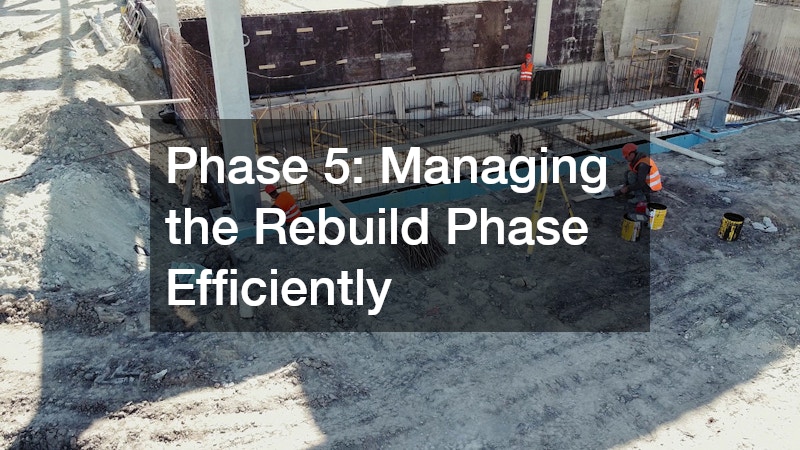
The active rebuild phase is a massive logistical puzzle. Every day the site is active costs you money, and every day of delay pushes back your ability to generate leasing revenue. As the property owner or representative, your primary role shifts to rigorous oversight, relentless communication, and timeline enforcement. You are the vital link between your financial stakeholders and your primary construction contractor, ensuring that the vision aligns with the physical reality on the ground. Furthermore, managing the complex, overlapping schedules of the dozens of specialized construction contractors—from structural steel erectors to commercial electricians and master plumbers—requires advanced project management software and an unyielding attention to detail.
Establish Clear Milestone Reporting Routines
You cannot manage what you do not measure. Passively waiting for updates is a guaranteed way to let a project slip behind schedule. You must institute a highly structured reporting rhythm.
-
Mandatory Weekly Site Walks: You, or your designated owner’s representative, must walk the site with the site superintendent every single week. This is not a casual stroll; it is an inspection to verify that the work billed for that week has actually been completed to standard.
-
Daily Digital Logs: Require the site manager to utilize project management software (like Procore or Buildertrend) to upload daily logs. These logs should include weather conditions, the number of workers on site, safety incidents, and photo documentation of progress.
-
The Critical Path Method (CPM): Utilize a CPM schedule. This isolates the sequence of project activities which add up to the longest overall duration. If a task on the critical path is delayed (e.g., pouring the foundation), the entire project is delayed. Monitoring the critical path allows you to triage problems instantly and authorize overtime only where it will actually save the schedule.
Coordinate Supply Chains to Prevent Project Bottlenecks
In modern commercial development, labor is only half the equation; material procurement is the other, often more volatile, half.
-
Identify Long-Lead Items Early: Certain components of a commercial build take months to manufacture and ship. Custom curtain-wall glass systems, commercial elevator cabs, specialized heavy-duty switchgears, and large-tonnage rooftop HVAC units cannot be bought off the shelf.
-
Pre-Ordering and Warehousing: Do not wait for the building to be framed to order the components that go inside it. Order long-lead items immediately upon finalizing the design. If the site is not ready for installation when the items arrive, it is often cheaper to pay for temporary off-site warehousing than to halt the entire construction project while waiting for a delayed shipment.
-
Alternative Material Sourcing: Work with your procurement team to pre-approve alternative materials. If a specific brand of ceramic tile or a particular grade of structural timber suddenly becomes unavailable, having a pre-approved, cost-equivalent backup ready to go prevents the supply chain from stalling out the finishing crews.
Conclusion
The journey from a deteriorating structure to a vibrant, state-of-the-art commercial facility is an arduous but highly rewarding endeavor. It demands a high tolerance for complexity, a willingness to engage deeply with regulatory bodies, and the financial acumen to weather unpredictable challenges. By systematically breaking the project down into strategic phases—meticulous teardown planning, rigorous compliance, controlled site clearing, visionary design, and disciplined project management—you transform a chaotic process into a structured pathway to success.
Ultimately, the goal of this entire undertaking is to maximize your property’s value and secure a dominant position in the local real estate market. A brand-new, modern building commands premium lease rates, attracts high-tier, reliable tenants, and significantly lowers ongoing maintenance and operational costs compared to an older structure.
While the scope of a complete redevelopment can feel overwhelming, you do not have to navigate it alone. Success lies in building a team of highly competent professionals who share your vision and understand the stakes. Take the first step today. Evaluate your underperforming properties, consult with structural engineers and financial advisors, and begin drafting the blueprint for your property’s revitalization. The opportunity to reshape your commercial portfolio and achieve unparalleled returns is waiting to be built.